Ion implantation is the primary doping method in the semiconductor industry. It is a technique that injects specific elements into a target material by utilizing electric fields for acceleration, as well as magnetic fields for mass separation and beam collimation; through high-precision control, it ensures the uniformity of the implanted dose.
Owing to its advantages—including precise control, anisotropic characteristics, and room-temperature processing—it is widely applied in fields such as integrated circuits, compound semiconductors, and display panels, thereby establishing itself as the mainstream doping process. Ion implantation equipment features complex structures and presents significant technical challenges, making it one of the critical pieces of machinery in the semiconductor manufacturing workflow.
Leveraging over two decades of experience in semiconductor R&D and manufacturing, coupled with continuous technological innovation, we have achieved breakthroughs in several key technologies—including electrostatic acceleration, dose control, and electromagnetic mass separation—leading to the development of two medium-current ion implanter models. The company remains committed to expanding its product portfolio to achieve comprehensive coverage of ion implantation equipment, thereby providing the semiconductor manufacturing sector with a complete suite of ion implantation solutions.
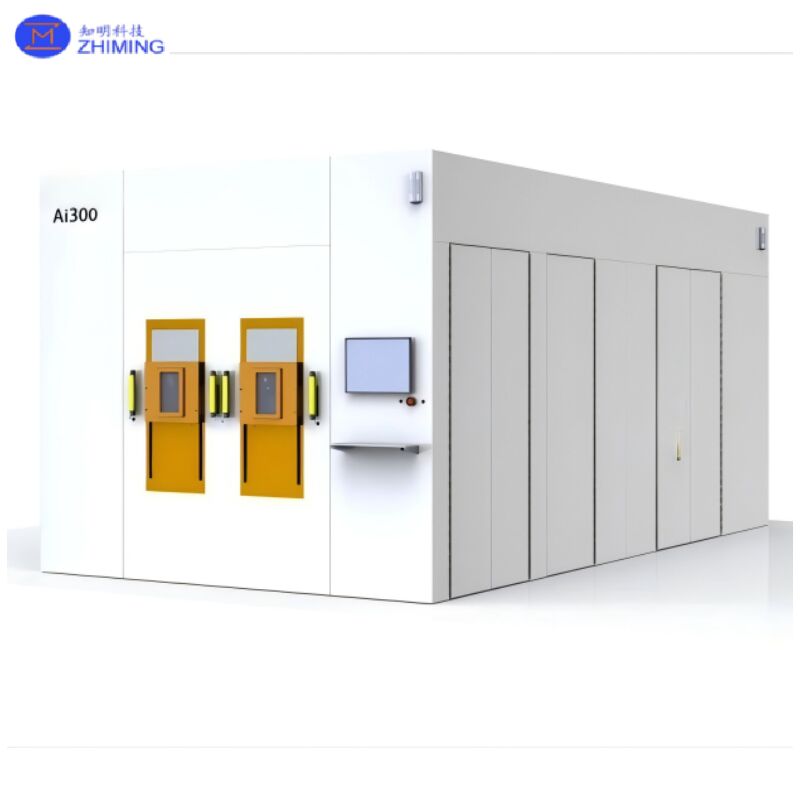
Ai300 MediumBeam Ion Implanter (12-inch)
(1) Product Overview
The Ai300 is a mediumbeam ion implantation system designed for 12-inch wafer processing in advanced semiconductor manufacturing. It is primarily used for medium-dose and medium-to-high energy implantation steps, including well formation, channelengineering, and lightly doped drain (LDD) structures in CMOS processes. The system provides precise control of dopant depth and concentrationprofiles through stablebeamdelivery and accurateangle control, enabling optimization of deviceelectricalcharacteristics.
(2) Key Specifications
Wafer size: 12 inch
Energy range: 5–300 keV
Implant species: C, B, P, N, He, Ar
Implant angle: 0°–45° (accuracy ≤0.1°)
Dose range: 1E11–1E16 ions/cm²
Beamstability: ≤10%/hour
Beam parallelism: ≤0.1°
Throughput: ≥500 WPH
Uniformity/Repeatability: ≤0.5%
(3) Technical Features and Advantages
The Ai300 integrates a high-stability ion source and advancedbeam control system, ensuringminimalbeamfluctuation during extendedoperation. Its excellent beam parallelism guarantees uniform dopant distribution across the wafer, which is critical for advanced nodes. In addition, its high throughput supports high-volumemanufacturing (HVM) requirements in 12-inch fabs.
(4) Applications
Advancedlogicdevices (CMOS, FinFET)
DRAM and NAND memory
Precision doping processes
FAQ
1. What is ion implantation and why is it important in semiconductor manufacturing?
Ion implantation is a process in which dopant ions are accelerated and implanted into a semiconductor substrate to modify its electricalproperties. Compared with traditional diffusion methods, ion implantation offers precise control over dopant concentration, depth, and lateral distribution, making it indispensable for advanced semiconductor devicefabrication.
2. What is the difference between mediumbeam and high beam ion implanters?
Mediumbeam implanters are typically used for precision doping applications with moderatedose and wider energy ranges, such as well formation and channelengineering. High beam implanters, on the other hand, are optimized for high-dose implantation with higher beamcurrents, commonly used for source/drainformation and contact engineering.
3. How do I choose the right ion implantation system for my process?